
Breeding
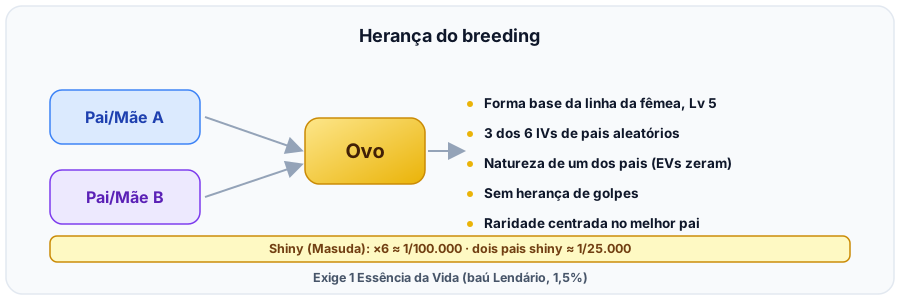
Breeding is poke-idle's refinement loop: you pair two compatible parents, spend one Essence of Life, and get an egg. The egg hatches into a level-1 offspring that inherits part of its parents, and can come out rarer, or even shiny.
The flow
- Pick two eligible parents (from the Box and/or team) and spend 1 Essence of Life, plus gold and Dust, to generate an egg.
- The egg's entire genetics (IVs, nature, egg moves, rarity and whether it is shiny) are decided the moment it's created.
- The egg takes 30 minutes to form. During that time it stays in the queue and cannot go into an incubator or onto the Market.
- Place the egg in a free incubator slot, this starts the timer.
- The egg hatches when time elapses, even while you're offline. While you hunt with the game open, it hatches twice as fast (see Sitting on the egg). The offspring drops into your Box.
Once you make an egg, both parents need to rest before breeding again. See Parent rest.
A pokémon caught with a Master Ball has a wait of its own before its first breeding. See The Master Ball wait.
What an egg costs
On top of the Essence, breeding charges gold and Dust by the average rarity of the pair. It is the same average that decides the offspring's rarity, so what you pay tracks what you expect to get: an Astral paired with a Common lands in the middle of the table.
| Pair | Gold | Dust |
|---|---|---|
| Common | 3,000 | 50 |
| Uncommon | 11,000 | 150 |
| Rare | 40,000 | 400 |
| Epic | 150,000 | 1,250 |
| Prismatic | 550,000 | 3,500 |
| Mythic | 1,140,000 | 8,000 |
| Astral | 2,700,000 | 20,000 |
| Divine | 6,600,000 | 35,000 |
A Common pair costs practically the same as it always did. The trainer who pairs good parents is the one who pays more, and the steps climb fast: each one up costs three to four times the one below.
The screen shows the price of the pair you picked before you make the egg, and names which step of the table it landed on. Swap a parent and the number changes right away.
Remember the offspring is born in its base form. Taking it to the final form costs Dust again, at evolution.
Why breeding costs so much
A good pair never wears out. Both parents stay yours after the egg, and you can use the same two pokémon for as long as you play. That is great, and it is exactly what needs a brake: with nothing holding it back, a pair of Astrals would be an Astral conveyor belt, and the rarest pokémon in the game would stop being worth anything.
So breeding has four costs, and each one holds back a different thing:
| The cost | What it holds back |
|---|---|
| Essence of Life | One egg per Essence. It only drops from Legendary-rank chests and above, so every breeding sits behind real hunting. |
| Gold and Dust | The better the pair, the pricier the egg. Breeding Astral costs 2,700,000 gold and 20,000 Dust, against 3,000 and 50 for a Common pair. |
| Parent rest | Limits how many eggs the same pair makes. An Astral pair delivers roughly one egg every 5 days. |
| Hatch time and slots | Limits how many eggs you have hatching at once. An Astral egg holds the slot for 30 days. |
Put together: a player with one Astral pair and one incubator slot gets about one Astral offspring a month, and pays well for it. With more slots and more pairs you get more, but the cost climbs with you.
None of this is meant to get in the way of someone learning. At the bottom of the ladder the numbers are small on purpose: 3,000 gold, 50 Dust, 4 hours of rest and 6 hours of hatching. The weight only shows up once what comes out of the egg is worth a lot.
And remember the ceiling: breeding goes up to Astral. Divine never comes from an egg, only from the Laboratory.
Incubators
An incubator slot is something you earn: you start with none. The three ways to get one:
| Where it comes from | How many | Speed |
|---|---|---|
| Incubator talent (single level) | +1 | normal |
| Active Premium | +1 | 30% faster |
| Founders Pack | +1, permanent | normal |
The Incubator Upgrade (50 Sapphire in the VIP Shop) makes one slot 40% faster forever. It only applies to common slots: the Premium one is already fast, and the founder one is a trophy. The Quick Hatch talent shortens every egg by up to 10%.
There is room for 5 common slots and 7 in total counting the founder and Premium ones. The game never removes a slot that still holds an egg.
The Essence of Life: the gate
The Essence of Life (the catalyst for all breeding) only drops from Legendary-rank chests, and even then only 0.5% per Legendary chest opened (and Legendary chests are themselves rare). Arena chests give 0.7% and Champion chests 1.3%. One Essence = one egg (consumed at creation).
Egg groups and gender
There are 15 authentic egg groups (canon Gen-3 names): Monster, Water1, Water2, Water3, Bug, Flying, Field, Fairy, Grass, HumanLike, Mineral, Amorphous, Dragon, Ditto, and NoEggs. Each species carries its groups, a male fraction, and whether it's breedable. Legendaries and special forms are NoEggs / not breedable. Each mon's gender is fixed as soon as it appears (it never changes); genderless species are 'N'.
Compatibility rules
- Both must be breedable and not the same individual.
- Two Dittos cannot breed.
- Ditto + any breedable non-Ditto (including genderless) → OK.
- Otherwise: they must share an egg group AND be opposite genders. A genderless non-Ditto cannot breed.
Where to find a Ditto
Ditto does not live in any region. It is not in any area's monster list, so there is no spot to park at and wait.
It shows up by lottery, on any hunt: every monster you defeat has a small chance of having been a disguised Ditto all along. The chance is 1 in 49,637 encounters. Hunting a region at your level, that is roughly one Ditto every ~43 hours of hunting (almost two days), on average. It works offline, like the rest of the hunt.
When it shows up it is a normal encounter: it goes through your catch filters, spends a ball, and can escape.
A Ditto is still the wildcard of breeding: it pairs with any breedable mon, and it is the only way to breed the 27 genderless species (Beldum, Magnemite, Porygon, Starmie and friends).
The offspring rules, in short
- Species: comes from the mother's line. The egg shows which parent gives the species.
- IVs: the offspring inherits 3 IVs from the parents; the others are random.
- Nature: copied from one of the parents.
- Moves: inherits 2 egg moves from the parents.
- Rarity: can go up, stay or go down compared to the parents.
- Gender and shiny: pure luck.
Offspring species
The offspring is the base form of the female's line (or the non-Ditto parent's line, when a Ditto is involved). E.g. breeding a female Ivysaur produces a Bulbasaur. The egg shows which parent gives the species; the species itself only shows up when it hatches.
The two families that break the rule. Nidoran and Volbeat/Illumise are not one Pokémon with two genders: they are two species, each locked to a single gender. For them the egg can come out as either half, and which one is luck:
| Pairing | What can hatch |
|---|---|
| Nidoran♀ (or Nidorina, or Nidoqueen) with a male | Nidoran♀ or Nidoran♂ |
| Illumise with Volbeat | Illumise or Volbeat |
You do not need a Ditto to get Nidoran♂ or Volbeat: just breed the female.
What the offspring inherits
| Attribute | Rule |
|---|---|
| Level | Hatches at level 1 |
| EVs | Always reset |
| IVs | Inherits 3 of the 6 IVs from the parents; the other 3 are random |
| Nature | Copied from one of the parents |
| Moves | 2 egg moves. Each species line has its own list of moves that only come from an egg, and the offspring gets one of them only if a parent knows it (its species learns it, or it was taught). Egg moves hatch already learned and lead the moveset; the rest is the species' default moveset |
| Gender | Luck |
| Shiny | Luck |
| Lineage | A snapshot of both parents is stored, with species, level, rarity, nature and all six IVs as they were on breeding day (survives their sale) |
Offspring rarity
The offspring's rarity starts at the average of the two parents, rounded up on a tie. It is the same average that sets the breeding price. From there it can go one tier up, stay at the average, or go one tier down. It never drops below Common nor goes above Astral: the breeding ceiling is Astral, and Divine is Lab-only.
The ladder is: Common · Uncommon · Rare · Epic · Prismatic · Mythic · Astral.
Shiny when breeding
Whether the offspring is shiny is luck, decided when the egg is created. It only shows at hatch: neither you nor whoever buys the egg knows beforehand.
A shiny parent helps: with one shiny parent the egg's chance doubles, and with both it goes up even more. The pair screen shows the exact chance ("1 in ...") before you breed.
Shiny does not change the offspring's rarity. Rarity is still the parents' average, with the same chances to go up, stay or drop.
Parent rest
Breeding is tiring. After an egg is made, each of the two parents spends some time unable to breed again. How long depends on the rarity of that parent, not of the egg.
The rest exists for the same reason as the gold and Dust price: without it, a good pair would be a conveyor belt of rare pokémon. See Why breeding costs so much.
| Parent rarity | Rest |
|---|---|
| Common | 4 h |
| Uncommon | 8 h |
| Rare | 16 h |
| Epic | 1 d |
| Prismatic | 2 d |
| Mythic | 3 d |
| Astral | 5 d |
| Divine | 7 d |
Since each parent counts its own rarity, an Astral bred with a Common leaves the Astral resting for 5 days and the Common for 4 hours. Lending your best pokémon to lift a weak pair costs you your best pokémon.
At the lower tiers the rest barely shows: if you breed a Common or Uncommon pair now and then, it is ready again by the next time you open the game. The weight sits at the top, which is where a repeated pair used to produce an offspring a day.
The breeding screen tells you when a parent is resting, and how long is left. A resting pokémon is still yours for everything else: it hunts, battles, evolves and can be sold as usual.
The Master Ball wait
In the hunt, a Master Ball catches almost any pokémon without failing. In exchange, whatever it catches waits 10 days, counted from the capture, before its first breeding.
The idea is simple: the ball that skips all the difficulty of the catch does not get to skip the wait too. Without that, a saved Master Ball would be a direct shortcut to the top of the breeding ladder.
What you need to know:
- In practice it applies to the hunt: the Boss Room and the Urban Legend refuse the Master Ball. The wait travels with the pokémon.
- It applies to new catches only. A Master Ball pokémon that was already in your Box before this rule is not affected.
- Once the 10 days pass, it breeds normally. From the first egg on it follows the ordinary rest for its rarity, like any other parent.
- The wait holds back nothing else. It hunts, battles, evolves, joins raids and can be sold from day one.
The breeding screen tells you when a parent is in this wait, and how long is left.
Hatch time by rarity
Rarity (and therefore hatch time) is fixed when the egg is created; species and shiny stay hidden in the UI until hatch.
| Rarity | Hatch time |
|---|---|
| Common | 6 h |
| Uncommon | 18 h |
| Rare | 2 d |
| Epic | 6 d |
| Prismatic | 12 d |
| Mythic | 20 d |
| Astral | 30 d |
Sitting on the egg
While you hunt with the game open, the eggs in your incubators hatch twice as fast: every hour of live hunting takes an extra hour off all of them. The incubator screen tells you when this is active, and each egg's timer runs faster while it is. A Hatch Potion takes exactly the time it promises off the timer.
- It only counts live hunting, with the game tab open in front. Offline time and a tab hidden in the background hatch at the normal pace. Sleeping in the bed counts: the hunt goes on, and so does the egg. When you come back to the tab, the double speed shows again within two and a half minutes.
- Taking an egg out of an incubator resets its progress, including what Hatch Potions took off. The screen asks you to confirm first.
- You have to actually be hunting: with no hunt, a stopped hunt or a fainted team, hatching runs at the normal pace.
- It stacks with the Hatch Potion and the faster slots: the potion cuts time on the spot, and live hunting speeds up whatever is left.
- An egg in a slot rented from another trainer does not count: it hatches at the slot's pace.
See also
- The talent that grants incubator slots: Talents.
- Where the Essence comes from (Legendary chests): Chests.
- The Divine ceiling: Fossils, Lab & Box.